Monday, 27 August 2007

Sweeney Vs the Nazis

I have no idea what posses someone to spend their weekends dressed in Waffen SS uniform re-enacting the most bloody conflict in human history. I have even less idea why they would consider it fun. Its tasteless, tacky and not a little weird. It really stretches Voltaire’s principle that ‘I may not like what you have to say but I will die for your right to say it’ to the limit because I really don’t like what they are doing and I would be rather reluctant to die for their right to do it. I will, however, happily write a blog piece defending their rights to do it.

Many European countries, mainly those that formed part of the Third Reich, have laws prohibiting expressions of support for Nazis and denying that the holocaust took place. These laws often include a ban on Nazi symbols and uniforms. There was a recent attempt by the German government to get this ban passed into EU law.

As a student of history such laws alarm me because if you are to have such a law it must cover historians if it is not to have an elephant sized loophole in it. Nazi memorabilia, books and the like are important historical sources. Even Nazi sympathisers have their value. The historian Ian Kershaw, the author of the definitive biography of Hitler, first became interested in the Nazi period after he encountered a former SS officer while studying in Germany and wanted to be able to explain his anti-Semitic rants. If we do not make use of all the sources at our disposal, our understanding of Nazism will be poorer and as a consequence we will be less able to learn the lessons of that dreadful period. And you know what they say about people who do not learn from history.

I am sympathetic to the idea that such a law would protect the feelings of
those who suffered at the hands of the Nazis. What they must feel when they see some twerp condoning or trivialising what happened to them is unimaginable but banning things because they cause offence is a dangerous game to get into. A lot of things cause offence to a lot of people. If we can only say things that don’t offend people then we will end up living in silence.

The effectiveness of these laws in combating the far right is dubious. They are as likely to create neo-nazi martyrs as they are to prevent people from being corrupted by propaganda. Austria, the country that locked up David Irving for holocaust denial was also the first country in Europe is also the country where Jorg Haider’s Freedom party got into government. Jean Marie Le Penn was convicted of holocaust denial but still got into the run off of the French presidential election. If we are to beat these fascists then we need to fight them at the ballot box and in debating chamber rather than in the courts.

If free speech is to mean anything then it cannot just apply to views we agree with. Upholding the rights of people like David Irving, Nick griffin and their fellow pond life is not a pleasant thing to do but it is something that needs to be done. Defending freedom of speech is worth doing because it gives you the right to say just what you think of Nazis.

An amnesty: the next best thing

In Britain today there is an underclass of people excluded from mainstream society, who's sole crime is to have sought a better life for themselves and their families. These people are immigrants in the UK illegally and the home office estimates that there may be six hundred thousand of them.

Many protectionists continue to harbour dreams of deporting these people but this is hardly a practical option. Think of how much it would cost, the UK already spends £5bn a year on deporting people and this would have to be increased many times to deport everyone. The last thing overstretched police forces need is to have to spend yet more time chasing immigrants rather than real criminals. Can you imagine how many coaches and planes we would to get these people home? Not to mention all the jobs they are currently doing being left unfilled. It is a crazy idea.

These people are here and they are here to stay. This leaves us with a choice the status quo of six hundred thousand people living in an illegal twilight zone, not paying taxes and working in the shadow economy or do we give these people the chance to end their internal exile.

The amnesty that has been proposed by Nick Clegg over the past few days is certainly a step in the right direction as it would be expected to take a significant number of people out of the illegal underclass and allow them to work legally and pay taxes.

There are, however, plenty of problems. The incompetence of the immigration directorate is so great that they would struggle to administer an amnesty. More fundamentally, it is at best a temporary measure. People will continue coming to the UK as long as there are jobs for them to do and we will eventually have to deal with a new population of illegal immigrants who arrived after the amnesty.

Better by far would be to end immigration controls and stop punishing people for wanting to live and work in a country other than the one they were born in. This would not only allow people to escape from the illegal underclass but put an end to human trafficking, relieve labour shortages in certain sectors of the economy and allow us to take advantage of new skills and ideas.

Unfortunately, free trade in labour is not going to a practical political option any time soon and on the principle that the best should not be the enemy of the good. I am happy to support calls for an amnesty and say: 'keep up the good work Nick.'

Saturday, 25 August 2007

The murder kingdom


In an earlier post on Venezuela I mentioned something about Chavez's regime presiding over 'rising crime.' This turns out to be something of an understatement.

The murder rate has tripled under Hugo Chavez, so that now Venezuela has the highest murder rate in the world. So much for the socialist utopia.

Hat tip: Prospect magazine's fact and figures column.

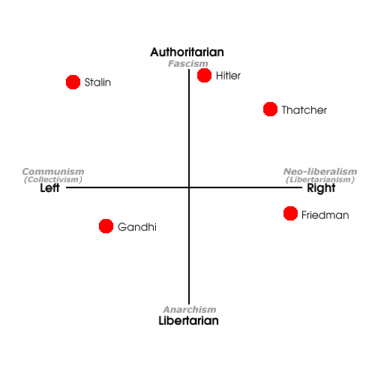
The Left/Right Delusion

It is almost always a mistake to try to apply the mantra: Keep It Simple Stupid to our attempts to understand the society we live in. Human being are complex creatures and trying to give us all simple labels in the same way one would species of Jellyfish will inevitably lead you to an incorrect conclusions. Perhaps the best example of this is the rather annoying way that every political viewpoint gets classified as either left or right wing.

One of the least constructive lessons of my educational career was an A-level politics class that was entirely taken up with the lecturer trying to convey to the class what the difference between a left wing and a right wing view was. He was struggling because they are purely arbitrary labels with no real meaning: there is no logical reason why wanting to renationalise the railways means that you are opposed to the death penalty. So providing a clear definition of them was something of a challenge.

Thinking in terms of left and right is a certain way to stop political creativity. An effective policy maker should be able to use every tool at their disposal without worrying about whether it is left wing or right wing. The hugely positive reaction to the New Labour sound bite: ‘tough on crime, tough on the causes of crime,’ suggests that this is something that most of us instinctively understand.

The idea that all political viewpoints are reducible to two simple opposites encourages the dangerous idea that ‘my enemy’s enemy is my friend.’ An example of this is are the strange views of John Pilger, which I wrote about a few days ago. I suspect that part of what drives Pilger to the conclusion that the like of Chavez and Castro are good leaders is a train of thought that runs something like this: ‘I am a left-winger who is opposed to American conservatives who are right wingers. Castro and Chavez also oppose these right wingers so must be like me left wingers and therefore friends of mine.’ I would hope that it goes without saying that, this is not a particularly sensible approach.

The terms left and right come from post-revolutionary France. In the assembly that governed France after the overthrow of the monarchy, those who wanted to restore the King to the throne sat on the right while those who wanted to behead him sat on the left. In this context and this context only does right and left make sense. Otherwise it is a nonsense.

The specific context of these terms has become a particular problem as more attention is given to non-western politics. Where as the politics of countries that had been shaped in part by the French revolution could usually be forced into the left and right straightjacket, this became impossible in countries with their own distinct political traditions. Take Taiwan, the main divide in its politics is between those who support independence and those who wish to remain (formally at least) part of China. How can this divide possibly be related to the seating arrangement of a two centuries old French parliament?

As long as people insist in reducing politics to a simple dichotomy the enormous diversity of ideologies, interests and ideas that drives modern politics will be obscured and we will only ever have a partial picture.

Monday, 20 August 2007

They come here, they look after our grannies...

Those who say that this country does not benefit from immigration should really give some thought to what happens when the immigrants go home. Immigrants are such an integral part of our economy and our society that we often stop noticing the contribution they make and only remember if they leave.

An unlikely alliance of the Filipino Embassy, a Conservative MP and the English Community Care Association have highlighted the problems that many care homes will face due to changes in immigration laws that will leave many of their staff unable to get visas.

The problems faced by care homes clearly shows up the myth that the way to manage immigration is for government to try to choose 'skilled' workers to admit and then try to stop anyone else getting. This is the philosophy behind the home offices new points based immigration system that is endorsed by the big three parties. The problem with this system is that low skilled immigrants can also be good for our economy. There are low skilled jobs like working in care homes, being a farm hand and cleaning that have to be done but which few British people will do. Immigrants are often willing to do what seem to them to be well paid jobs and we are mad to try to stop them.

There is a far better system for regulating the the movement of people from country to country. It's called the market and it has shown time and again that it is the best way to control the movement of labour around countries and there is no reason to believe that it cannot do the same for movements between countries.

Sunday, 19 August 2007

The Apologist

Whatever else can be said about John Pilger (and there is plenty to say), he has definitely got guts. His attempt to whitewash Hugo Chavez’s record in Thursday's Guardian is bold, brazen and blatant. He casually downplays, excuse or outright ignores the abuses of Chavez’s regime, while overstating its success and doing everything in his power to make everything the fault of Americans.

In the week that Chavez has declared himself president for life (i.e: dictator), it is extraordinary that Pilger makes no mention of this. Nor for that matter does he mention Chavez replacing the independent judiciary with political cronies, riot police being set on peaceful protesters or the harassment suffered by voters who signed the petition calling for a recall referendum.

What he does manage to include are obligatory references to the Chilean coup of 1973 and the Iran-Contra scandal and darkly hint that there is some comparison between what is going on now and what happen then. The reality is rather different. The United States has not actively tried to overthrow. It is true that that the state department failed to condemn the attempted military coup against Chavez but this a far cry from sending the CIA in to topple the government as would once have happened.

Pilger attempts to excuse Chavez’s attempt to close RCTV on the grounds that ‘80% of TV stations are owned by private companies many of which are hostile to the regime is certainly creative but falls down on many grounds. If the Labour Government in Britain tried to close down the Independent, few would consider it a legitimate defence, if the government claimed: ‘well there are plenty of other opposition newspapers.’ What Pilger also ignores is the way that pressure has been put on the owners of other TV stations to avoid criticising the regime, for example, by passing a law requiring journalists to tell the ‘truth,’ a law which will be enforced by the Chavista judiciary. Pilger’s attempt to suggest that RCTV is being closed down because of its support for the coup rather than its criticism of Chavez, is dubious to say the least. If RCTV’s real crime had been to back the coup then why not punish them at the time rather than four years later?

Pilger is full of praise for Venzuela’s social program and rightly so: we can all support better healthcare and education. Where Pilger’s falls down is when he tries to use these programs to excuse the regimes human rights abuses and when he gives Chavez credit for these programs.

To justify the erosion of democracy and human rights because they have coincided with the construction of new schools, hospitals and universities is no different from claiming that Mussolini’s fascist regime was okay because it made the trains run on time. To follow this line of reasoning implies that democratic government and personal freedom are something that a government can dispose with if it finds them inconvenient rather than a non negotiable part of any just society.

It must also be borne in mind that the reason that these programs have come into existence is not because Chavez is a particularly benevolent ruler or because he has discovered a more just economic system but because rising oil prices have given him more money to play with than previous governments.

It is also worth bearing in mind that his record is a far from unblemished. Crime and corruption are up. Inflation is running at 20% and income inequality is rising.

A particularly cutting analysis of the logic of Pilger and his ilk is provided by Francis Wheen in his book ‘How Mumbo Jumbo conquered the world.’ He looks at Pilger’s attitude to East Timor. For twenty-five years Pilger lamented the West’s failure to intervene to protect the people of East Timor from their Indonesian oppressors. When an Australian led UN peacekeeping force was eventually dispatched to East Timor rather than rejoicing Pilger, condemned the intervention as a sign of Western imperialism. As Wheen puts it: ‘To Pilger … it is axiomatic that the west can never be right.’

Pilger’s conviction that the west is always wrong leads him to believe that only the West can do wrong and therefore that actions committed by opponents of the west are always right. This is a dangerous delusion that leads him to condone actions that run contrary to the values he claims to uphold. Shame on Pilger and shame on those believe his claim to be a fighter for the oppressed.

Saturday, 18 August 2007

Strange Fruit

There's an excellent article in todays Guardian looking at the story of Billie Holiday's song 'a strange fruit.' It is written by a playwright who named a play 'Strange Fruit' unaware of the connotations it has for many people. He only found out when he found himself on a long car journey through Alabama with the father of a girl murdered by the Klu Klux Klan. It is a fascinating read and I recommend, nay insist, that you read it.